1. Introduction
Modern electric power systems are increasingly challenged by power quality (PQ) issues arising from the widespread use of power electronic devices and renewable energy sources
| [1] | Singh B, Al-Haddad K, Chandra A. A review of active filters for power quality improvement. IEEE Transactions on Industrial Electronics. 1999; 46(5): 960–971. |
| [2] | IEEE Std 519-2014: IEEE Recommended Practice and Requirements for Harmonic Control in Electric Power Systems. Institute of Electrical and Electronics Engineers (IEEE); 2014. |
[1, 2]
. Non-linear loads such as variable-speed drives, rectifiers, and inverters draw distorted currents that introduce harmonics into the grid, leading to voltage distortion, increased losses, and equipment malfunctions
| [3] | Kalair A, Abas N, Kalair AR, Saleem Z, Khan N. Review of harmonic analysis, modeling and mitigation techniques. Renewable and Sustainable Energy Reviews. 2017; 78: 1152–1187. |
| [4] | Khomsi C, Bouzid M, Jelassi K. Grid connected PV system supplying a non-linear load for improved grid current quality. In: 2016 7th International Conference on Sciences of Electronics, Technologies of Information and Telecommunications (SETIT); 2016. p. 489–494. |
[3, 4]
. Likewise, grid-connected renewable energy sources (e.g. solar PV and wind) interfaced through power converters can generate harmonic currents and voltage fluctuations
| [5] | Nayak N, Acharya DP, Choudhury S, Padhy R. Power quality improvement in a fuel-cell based micro-grid with shunt active power filter. International Journal of Renewable Energy Research (IJRER). 2020; 10(3): 1071–1082. |
| [6] | Sundarabalan CK, Puttagunta Y, Vignesh V. Fuel cell integrated unified power quality conditioner for voltage and current reparation in four-wire distribution grid. IET Smart Grid. 2019; 2(1): 60–68. |
[5, 6]
. These PQ problems, if left unmitigated, can reduce system efficiency and reliability. Standards such as IEEE-519 prescribe strict limits (e.g. <5% Total Harmonic Distortion (THD) at the point of common coupling) to ensure acceptable PQ
| [7] | Qureshi MB, Qamar S, Ali SW, Khalid U. Recurrent neuro-fuzzy control of grid-interfaced solid oxide fuel cell system. International Journal of Systems, Control and Communications. 2018; 9(1): 31–52. |
| [8] | Mosaad MI, Ramadan HS. Power quality enhancement of grid-connected fuel cell using evolutionary computing techniques. International Journal of Hydrogen Energy. 2018; 43(5): 11568–11582. |
[7, 8]
. Meeting these PQ standards is essential to avoid penalties and protect sensitive equipment
| [3] | Kalair A, Abas N, Kalair AR, Saleem Z, Khan N. Review of harmonic analysis, modeling and mitigation techniques. Renewable and Sustainable Energy Reviews. 2017; 78: 1152–1187. |
| [4] | Khomsi C, Bouzid M, Jelassi K. Grid connected PV system supplying a non-linear load for improved grid current quality. In: 2016 7th International Conference on Sciences of Electronics, Technologies of Information and Telecommunications (SETIT); 2016. p. 489–494. |
[3, 4]
.
Traditional solutions for harmonic and reactive power compensation used passive filters; however, passive filters have limitations like fixed compensation, risk of resonance, and bulkiness
| [9] | Choudhury S, Arshad J, Mohanty S, Dey L. Harmonic profile enhancement of grid connected fuel cell through cascaded H-bridge multi-level inverter and improved squirrel search optimization technique. Energies. 2021; 14(23): 7947. |
| [10] | Choudhury S, Nayak N, Acharya DP. Design of fuzzy and HBCC based adaptive PI control strategy for an islanded microgrid with solid oxide fuel cell. International Journal of Renewable Energy Research (IJRER). 2017; 7(1): 34–44. |
[9, 10]
. Active Power Filters (APFs) have emerged as an effective alternative, offering dynamic PQ improvement by actively injecting compensating currents to cancel harmonics and supply reactive power on demand
| [11] | Nair DR, Nair MG, Thakur T. A smart microgrid system with artificial intelligence for power-sharing and power quality improvement. Energies. 2022; 15(15): 5409. |
| [12] | Kamel AA, Rezk H, Abdelkareem MA. Enhancing the operation of fuel cell-photovoltaic-battery-supercapacitor renewable system through a hybrid energy management strategy. International Journal of Hydrogen Energy. 2021; 46(9): 6061–6076. |
[11, 12]
. In particular, the shunt APF (SAPF) is widely used to eliminate current harmonics and correct power factor in distribution systems
| [11] | Nair DR, Nair MG, Thakur T. A smart microgrid system with artificial intelligence for power-sharing and power quality improvement. Energies. 2022; 15(15): 5409. |
| [12] | Kamel AA, Rezk H, Abdelkareem MA. Enhancing the operation of fuel cell-photovoltaic-battery-supercapacitor renewable system through a hybrid energy management strategy. International Journal of Hydrogen Energy. 2021; 46(9): 6061–6076. |
[11, 12]
. APF technology has matured over the years and is proven to maintain near-ideal current waveforms, thus substantially improving power quality in compliance with standards
| [9] | Choudhury S, Arshad J, Mohanty S, Dey L. Harmonic profile enhancement of grid connected fuel cell through cascaded H-bridge multi-level inverter and improved squirrel search optimization technique. Energies. 2021; 14(23): 7947. |
| [11] | Nair DR, Nair MG, Thakur T. A smart microgrid system with artificial intelligence for power-sharing and power quality improvement. Energies. 2022; 15(15): 5409. |
[9, 11]
.
Recently, researchers have explored leveraging existing renewable/distributed generation inverters to also function as APFs, thereby improving PQ without dedicated hardware. For example, the inverter of a grid-connected PV system can be controlled to simultaneously inject power and filter local harmonics
| [13] | Jumani U, Abusara MA, Guerrero JM. Salp swarm optimization-based controller for dynamic response and power quality enhancement of an islanded microgrid. Processes. 2019; 7(11): 840. |
[13]
. Khomsi
et al. demonstrated that a PV inverter with appropriate control can act as a SAPF to clean up the grid current supplying a non-linear load
| [14] | Fan J, Li H, Ye L, et al. Recent development of hydrogen and fuel cell technologies: A review. Energy Reports. 2021; 7: 8421–8446. |
[14]
. This multi-function operation of renewable energy inverters enhances overall system efficiency and power quality. Following this idea, integrating a fuel cell – a clean DC power source – with an APF is a promising approach for PQ enhancement. Fuel cells generate electricity electrochemically with minimal emissions, and their integration in a power system can provide both steady power and ancillary services like harmonic compensation
| [15] | Tang S, Tesler F, Marlasca FG, et al. PEM fuel cell-based dynamic voltage restorer for mitigation of voltage disturbances in distribution systems. International Journal of Hydrogen Energy. 2017; 42(1): 603–613. |
| [16] | Singh, Anand & Baredar, Prashant. (2015). Power quality analysis of shunt active power filter based on renewable energy source. 2014 International Conference on Advances in Engineering and Technology Research, ICAETR 2014.
https://doi.org/10.1109/ICAETR.2014.7012836 |
[15, 16]
. Notably, fuel cell systems have been utilized in microgrids to support voltage and frequency control, and their fast control capability (when buffered by power electronics) can be tapped for PQ improvement
| [15] | Tang S, Tesler F, Marlasca FG, et al. PEM fuel cell-based dynamic voltage restorer for mitigation of voltage disturbances in distribution systems. International Journal of Hydrogen Energy. 2017; 42(1): 603–613. |
| [16] | Singh, Anand & Baredar, Prashant. (2015). Power quality analysis of shunt active power filter based on renewable energy source. 2014 International Conference on Advances in Engineering and Technology Research, ICAETR 2014.
https://doi.org/10.1109/ICAETR.2014.7012836 |
[15, 16]
.
Several studies have investigated fuel cell-based solutions for power quality. Acharya
et al. | [5] | Nayak N, Acharya DP, Choudhury S, Padhy R. Power quality improvement in a fuel-cell based micro-grid with shunt active power filter. International Journal of Renewable Energy Research (IJRER). 2020; 10(3): 1071–1082. |
[5]
developed a fuel-cell supported microgrid where a shunt APF mitigated harmonics and maintained voltage stability. Sundarabalan
et al. | [6] | Sundarabalan CK, Puttagunta Y, Vignesh V. Fuel cell integrated unified power quality conditioner for voltage and current reparation in four-wire distribution grid. IET Smart Grid. 2019; 2(1): 60–68. |
[6]
proposed a Fuel-Cell Integrated Unified Power Quality Conditioner (FCI-UPQC) combining series and shunt active filters in a four-wire system. In their work, a PEM fuel cell was tied to the common DC link of the UPQC, providing real power support during voltage sags and outages while the APF sections compensated current and voltage distortions
| [15] | Tang S, Tesler F, Marlasca FG, et al. PEM fuel cell-based dynamic voltage restorer for mitigation of voltage disturbances in distribution systems. International Journal of Hydrogen Energy. 2017; 42(1): 603–613. |
| [16] | Singh, Anand & Baredar, Prashant. (2015). Power quality analysis of shunt active power filter based on renewable energy source. 2014 International Conference on Advances in Engineering and Technology Research, ICAETR 2014.
https://doi.org/10.1109/ICAETR.2014.7012836 |
[15, 16]
. This resulted in improved voltage sag mitigation and harmonic reduction, with the fuel cell injecting power to critical loads during supply disturbances
| [6] | Sundarabalan CK, Puttagunta Y, Vignesh V. Fuel cell integrated unified power quality conditioner for voltage and current reparation in four-wire distribution grid. IET Smart Grid. 2019; 2(1): 60–68. |
[6]
. Tang
et al. | [15] | Tang S, Tesler F, Marlasca FG, et al. PEM fuel cell-based dynamic voltage restorer for mitigation of voltage disturbances in distribution systems. International Journal of Hydrogen Energy. 2017; 42(1): 603–613. |
[15]
similarly used a PEMFC-powered Dynamic Voltage Restorer (DVR) to correct voltage sags/swells in distribution feeders. These approaches underscore that integrating fuel cell distributed generation with custom power devices can significantly enhance PQ and ride-through capability in renewable-rich grids.
A key challenge in such integrated systems is the control strategy. The APF must respond rapidly to cancel harmonics and regulate reactive power, while the fuel cell output must be managed to maintain the APF’s DC-link voltage and supply real power as needed. Conventional linear controllers (e.g. PI controllers) are commonly used for APFs (to regulate currents and DC-link voltage). However, maintaining optimal performance under varying conditions (changing load, renewable output, fuel cell dynamics) can be difficult with fixed-gain PI controllers. Fuel cells, especially types like Solid Oxide Fuel Cells (SOFC), have slower electrochemical dynamics and require careful control to avoid fuel starvation and voltage transients
| [17] | Kumar, G & Mallidi, Raghavendra. (2017). Adaptive Droop Control Shunt Active Filter and Series AC Capacitor Filter for Power Quality Improvement in Power System. |
| [18] | Pedapenki, Kishore Kumar. (2016). Shunt Active Power Filter with MATLAB and d’SPACE 1104 Verification. International Journal of Applied Engineering Research. 11. 4085-4090. |
[17, 18]
. Advanced control techniques have been explored to address these challenges. Artificial Intelligence (AI) based controllers – including fuzzy logic and neural networks – offer adaptive, non-linear control capabilities that can outperform traditional PI controllers in PQ applications
| [19] | Elangovan, Dr S & Thanushkodi, K. (2014). A Two-Level Shunt Active Power Filter without PLL for Industrial Loads. Australian Journal of Basic and Applied Sciences. 8. 71-77. |
| [20] | Mhawi, Ekhlas & Daniyal, Hamdan & Sulaiman, Mohd Herwan. (2015). Performance analysis of active power filter for harmonic compensation using PI-PSO. Journal of Engineering and Applied Sciences. 10. 7. |
[19, 20]
. For instance, Sundarabalan
et al. | [6] | Sundarabalan CK, Puttagunta Y, Vignesh V. Fuel cell integrated unified power quality conditioner for voltage and current reparation in four-wire distribution grid. IET Smart Grid. 2019; 2(1): 60–68. |
[6]
employed an Adaptive Neuro-Fuzzy Inference System (ANFIS) controller to regulate the DC-link of an FCI-UPQC, which improved dynamic response and maintained stable operation under varying loads. Qureshi
et al. | [7] | Qureshi MB, Qamar S, Ali SW, Khalid U. Recurrent neuro-fuzzy control of grid-interfaced solid oxide fuel cell system. International Journal of Systems, Control and Communications. 2018; 9(1): 31–52. |
[7]
designed a recurrent neuro-fuzzy controller for a grid-connected SOFC system, demonstrating more accurate and stable control of fuel cell output compared to a conventional feedforward approach. Likewise, Choudhury
et al. | [10] | Choudhury S, Nayak N, Acharya DP. Design of fuzzy and HBCC based adaptive PI control strategy for an islanded microgrid with solid oxide fuel cell. International Journal of Renewable Energy Research (IJRER). 2017; 7(1): 34–44. |
[10]
implemented a fuzzy logic supervised adaptive PI control in an islanded SOFC microgrid to enhance transient stability and power sharing. These “hybrid” controllers (combining neural/fuzzy intelligence with conventional control structures) can learn and adapt to system non-linearity, making them well-suited for managing the fuel cell and APF coordination.
Another important aspect is optimization of controller parameters. To achieve optimal PQ improvement (e.g. minimum THD, minimal voltage deviation) under different operating scenarios, recent works have applied computational optimization algorithms. Mosaad and Ramadan
| [8] | Mosaad MI, Ramadan HS. Power quality enhancement of grid-connected fuel cell using evolutionary computing techniques. International Journal of Hydrogen Energy. 2018; 43(5): 11568–11582. |
[8]
introduced evolutionary algorithms – Harmony Search, modified flower pollination, etc. – to tune the gains of dual PI controllers in a grid-connected fuel cell inverter. Their optimized controllers yielded significantly lower THD and faster response than manually tuned PI regulators. Similarly, meta-heuristic techniques like Particle Swarm Optimization (PSO), Genetic Algorithms (GA), and newly developed swarm intelligence methods have been used to design or tune APF controllers for enhanced performance. For example, Jumani
et al. | [13] | Jumani U, Abusara MA, Guerrero JM. Salp swarm optimization-based controller for dynamic response and power quality enhancement of an islanded microgrid. Processes. 2019; 7(11): 840. |
[13]
utilized a Salp Swarm Optimization-based controller to improve the dynamic response and PQ of an islanded microgrid, while Choudhury
et al. | [9] | Choudhury S, Arshad J, Mohanty S, Dey L. Harmonic profile enhancement of grid connected fuel cell through cascaded H-bridge multi-level inverter and improved squirrel search optimization technique. Energies. 2021; 14(23): 7947. |
[9]
employed a novel Squirrel Search Optimization to determine the switching angles of a cascaded multilevel inverter for a fuel cell system, achieving a greatly improved harmonic profile (THD reduction) at the grid. These approaches highlight that combining advanced control with optimization can substantially improve PQ outcomes.
2. System Model and Hybrid Control Strategy
2.1. System Configuration
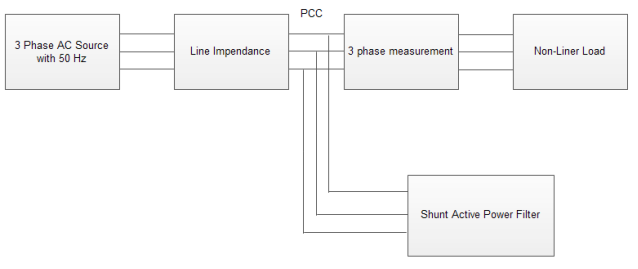
The target system is a grid-connected hybrid renewable energy setup consisting of a solar photovoltaic (PV) source, a fuel cell energy source, a three-phase distribution network, and local non-linear loads. A simplified single-line diagram of the system is as follows: the PV array is interfaced to the AC grid via a DC-AC inverter supplying active power to the grid. The local load (e.g. a three-phase diode rectifier feeding an R-L load) draws non-linear current, causing harmonics in the grid current. To compensate for these power quality issues, a shunt Active Power Filter (APF) is connected at the Point of Common Coupling (PCC). The APF is implemented using a voltage source inverter (VSI) with IGBT switches, tied in parallel to the grid through coupling inductors. Uniquely, the DC side of the APF is not just a capacitor bank; it is integrated with a fuel cell system (through a DC-DC converter interface). The fuel cell provides a controllable DC voltage/source that sustains the DC-link of the APF and injects real power when needed for compensation losses or support to the grid. In effect, the fuel cell + APF combination acts as a controllable current source that can inject or absorb power at harmonic frequencies and compensate reactive power, while also contributing active power from the fuel cell. This integration allows the fuel cell to operate not only as a generator but also as a dynamic power conditioner for the grid.
Figure 1. System Model and Hybrid Control Strategy.
For the fuel cell, a Proton Exchange Membrane Fuel Cell (PEMFC) is chosen in this design, given its favorable characteristics for distributed generation
| [21] | Chavan, Pranita & Patil, Babasaheb. (2025). Design and development of harmonic filters for harmonics reduction in polluted distribution network. Bulletin of Electrical Engineering and Informatics. 14. 3359-3370.
https://doi.org/10.11591/eei.v14i5.9504 |
| [22] | Mahdi, Dheyaa & Gorel, Goksu. (2022). Design and Control of Three-Phase Power System with Wind Power Using Unified Power Quality Conditioner. Energies. 15. 7074.
https://doi.org/10.3390/en15197074 |
[21, 22]
. PEMFCs operate at relatively low temperatures and can respond to load changes faster than high-temperature fuel cells, making them suitable for handling the varying power demands in APF operation
| [6] | Sundarabalan CK, Puttagunta Y, Vignesh V. Fuel cell integrated unified power quality conditioner for voltage and current reparation in four-wire distribution grid. IET Smart Grid. 2019; 2(1): 60–68. |
[6]
. The PEMFC stack produces a DC output voltage, which is connected to the APF’s DC link via a DC-DC boost converter. The converter regulates the fuel cell output, controlling the DC-link voltage ($V_{DC}$) to the desired setpoint (e.g. around 700 V for a 415 V AC system). The fuel cell system is modeled considering its key internal voltage drops: activation losses, ohmic losses, and concentration losses
| [23] | Tuna, Murat & AMAÇ, Ayşe & Kocabey, Sureyya. (2018). Mathematical modelling of PAF with voltage supply for non-linear loads By GSSA method. SAÜ Fen Bilimleri Enstitüsü Dergisi. 22. 1071-1079.
https://doi.org/10.16984/saufenbilder.315352 |
| [24] | Chinnayan Karuppaiyah Sundarabalan, Yeseswini Puttagunt “Fuel cell integrated unified power quality conditioner for voltage and current reparation in four-wire distribution grid” IET Smart Grid, 2019, Vol. 2 Iss. 1, pp. 60-68. |
[23, 24]
. However, in the control design, the fuel cell’s slower dynamics (due to fuel processing and thermal inertia) are buffered by the DC-link capacitor and the DC-DC converter, allowing the APF inverter to meet fast transient demands while the fuel cell supplies the average power component.
2.2. Control Architecture
The control strategy for the fuel cell integrated APF is hierarchical, comprising an outer-loop controller for DC-link voltage (and fuel cell power) and an inner-loop controller for APF current injection. This hybrid control scheme combines conventional and intelligent control elements as well as an optimization layer for tuning.
1) Reference Signal Generation: Using measurements of PCC voltages and load currents, the reference compensating current for the APF is computed in real time. We employ the Synchronous Reference Frame (SRF) theory (also known as the $d$–$q$ transformation method) for extracting the fundamental components of load current
| [25] | Shawon Das, H. M. Ishrak, Md. Mahadi Hasan, Md Ahsan Kabir, Empirical analysis of power quality using UPQC with hybrid control techniques, Results in Engineering, 20, (101527), (2023). https://doi.org/10.1016/j.rineng.2023.101527 |
| [26] | Digvijay Bhimrao Kanase, H. T. Jadhav, Solar PV System and Battery-operated DSTATCOM for Power Quality Enhancement: A Review, MAPAN, 39, 3, (751-773), (2024).
https://doi.org/10.1007/s12647-023-00733-y |
[25, 26]
. The three-phase load currents (I
La, I
Lb, I
Lc) are transformed into the d–q axis rotating frame using a PLL-synchronized transformation. The harmonic and reactive components manifest as AC ripples or non-DC quantities in the d–q frame and are separated using low-pass filters
| [27] | M. Chitra, P. Sakthivel, Power quality optimization in hybrid renewable energy system using MDNSOGI-based predictive control, Electrical Engineering, 107, 11, (14735-14754), (2025). https://doi.org/10.1007/s00202-025-03291-5 |
[27]
. By setting the reference for the load reactive and harmonic currents to zero, we derive the compensating current references I
ca, I
cb for the APF. Essentially, the APF is commanded to supply the non-fundamental portion of the load current, so that the source only needs to supply the fundamental active current demand of the load
| [11] | Nair DR, Nair MG, Thakur T. A smart microgrid system with artificial intelligence for power-sharing and power quality improvement. Energies. 2022; 15(15): 5409. |
| [12] | Kamel AA, Rezk H, Abdelkareem MA. Enhancing the operation of fuel cell-photovoltaic-battery-supercapacitor renewable system through a hybrid energy management strategy. International Journal of Hydrogen Energy. 2021; 46(9): 6061–6076. |
[11, 12]
. In this manner, unity power factor and sinusoidal current draw from the grid can be achieved. An alternative strategy is the instantaneous power (p–q) theory
| [20] | Mhawi, Ekhlas & Daniyal, Hamdan & Sulaiman, Mohd Herwan. (2015). Performance analysis of active power filter for harmonic compensation using PI-PSO. Journal of Engineering and Applied Sciences. 10. 7. |
| [27] | M. Chitra, P. Sakthivel, Power quality optimization in hybrid renewable energy system using MDNSOGI-based predictive control, Electrical Engineering, 107, 11, (14735-14754), (2025). https://doi.org/10.1007/s00202-025-03291-5 |
[20, 27]
, which was also tested and yields equivalent reference signals; however, the SRF method is adopted here for its ease of implementing decoupled d–q control.
2) APF Current Control (Inner Loop): The APF inverter tracks the reference currents using a high-bandwidth current control loop. A hysteresis band current control is implemented due to its simplicity and excellent dynamic response. The measured filter currents (I
fa, I
fb, I
fc) are compared with the reference compensating currents, and the inverter gating signals are generated such that the error is kept within a small hysteresis band. This results in the APF injecting currents that cancel out the load’s harmonic and reactive currents in real time. The switching frequency varies with load changes, but is limited by design (around 10 kHz) to balance performance and switching losses. The outcome of this inner loop is a set of near-perfect sinusoidal source currents in phase with the source voltages. In our simulations, the source current THD is brought down from ~25% (without APF) to about 3–5% with the APF active, which meets IEEE-519 requirements
| [2] | IEEE Std 519-2014: IEEE Recommended Practice and Requirements for Harmonic Control in Electric Power Systems. Institute of Electrical and Electronics Engineers (IEEE); 2014. |
[2]
.
3) DC-Link Voltage and Fuel Cell Control (Outer Loop): The outer control loop regulates the DC-link voltage V
DC of the APF, which is crucial for sustaining the APF’s ability to generate compensating currents. Any deviation in V
DC indicates an imbalance between the APF’s power injection and the power supplied by the fuel cell (plus any grid support). A reference DC voltage V
DC is set (based on the needed inverter output amplitude). We utilize an adaptive neuro-fuzzy (ANFIS) controller in this loop to account for the non-linear dynamics of the fuel cell and load variations. The ANFIS controller takes the error and its derivative as inputs and outputs a control signal that adjusts the fuel cell’s DC-DC converter, thus modulating the fuel cell current output. The use of ANFIS (a hybrid of neural network and fuzzy logic) allows the controller to auto-tune and handle system uncertainties. Initially, a conventional PI controller is designed for V
DC control (using small-signal linearization of the fuel cell/DC-link dynamics). The PI gains are then used to train the ANFIS off-line, as suggested in
| [6] | Sundarabalan CK, Puttagunta Y, Vignesh V. Fuel cell integrated unified power quality conditioner for voltage and current reparation in four-wire distribution grid. IET Smart Grid. 2019; 2(1): 60–68. |
[6]
. The trained ANFIS is implemented online to provide more robust, adaptive control than a fixed PI. This approach, similar to the method in
| [6] | Sundarabalan CK, Puttagunta Y, Vignesh V. Fuel cell integrated unified power quality conditioner for voltage and current reparation in four-wire distribution grid. IET Smart Grid. 2019; 2(1): 60–68. |
[6]
, yields faster recovery of V
DC during transients (e.g., when a sudden load change causes a dip in V
DC, the ANFIS quickly adjusts fuel cell power to restore it). Maintaining V
DC at its reference ensures the APF always has sufficient voltage headroom to inject currents and also indirectly dictates how much real power the fuel cell must supply (to cover the APF losses and any real power deficit of the load during disturbances). In steady state under nominal conditions, the fuel cell mainly compensates losses (which are small), so its hydrogen consumption is efficient. During events like a large sag or a temporary peak load, the fuel cell can inject additional active power via this DC-link control to support the grid, as demonstrated in
| [6] | Sundarabalan CK, Puttagunta Y, Vignesh V. Fuel cell integrated unified power quality conditioner for voltage and current reparation in four-wire distribution grid. IET Smart Grid. 2019; 2(1): 60–68. |
[6]
.
4) Hybrid Controller Structure: The combination of fuzzy logic in ANFIS with the conventional control forms a hybrid controller. It leverages human-like reasoning (fuzzy inference rules) and learning ability (neural network training) to handle the non-linear fuel cell APF system
| [28] | Li Wang, Ting-You Li, Ching-Chung Tseng, Yaw-Juen Wang, Hazlie Mokhlis, Kein Huat Chua, Manoj Tripathy, Shih-Chieh Hsu, Stability Analysis of Two Renewable Systems Fed to Two Power Grids through a Four-Terminal HVDC Link based on a Modular Multilevel Converter, 2025 IEEE/IAS 61st Industrial and Commercial Power Systems Technical Conference (I&CPS), (1-8), (2025).
https://doi.org/10.1109/ICPS64254.2025.11030367 |
| [29] | Abdelkader Mostefa, Karim Belalia, Tayeb Lantri, Houari Merabet Boulouiha, Ahmed Allali, A four-line active shunt filter to enhance the power quality in a microgrid, International Journal of Renewable Energy Development, 12, 3, (488-498), (2023). https://doi.org/10.14710/ijred.2023.50270 |
[28, 29]
. The rule base of the fuzzy controller is designed to emulate a variable-gain PI controller: for large V
DC error, a stronger action is applied, and for small error, fine adjustments are made. This adaptiveness prevents overshoot and oscillations that a fixed-gain PI might cause when the fuel cell operating conditions change (e.g., hydrogen flow delay, temperature effects). Qureshi
et al. | [7] | Qureshi MB, Qamar S, Ali SW, Khalid U. Recurrent neuro-fuzzy control of grid-interfaced solid oxide fuel cell system. International Journal of Systems, Control and Communications. 2018; 9(1): 31–52. |
[7]
showed that such neuro-fuzzy controllers can improve the accuracy of fuel cell power control, which aligns with our results.
5) Optimization of Controller Parameters: To further enhance performance, we integrate an offline optimization step using Particle Swarm Optimization. The PSO algorithm is used to tune key control parameters that are not directly adjusted by ANFIS learning. This includes the initial PI gains (which serve as baseline for ANFIS training) and other parameters like the DC-link reference V
DC and hysteresis band width, within permissible ranges. The objective is to minimize a multi-objective cost function that considers: (i) steady-state THD of source current (to minimize harmonics), (ii) transient response metrics of V
DC (overshoot and settling time, to ensure stability and quick recovery), and (iii) fuel cell constraints such as maximum current ramp rate (to avoid stress on the fuel cell). The cost function is formulated so that a solution yielding low THD and fast VDC regulation with limited fuel cell stress will have the lowest cost. PSO is chosen for its simplicity and effectiveness in handling non-linear optimization problems in controller tuning
| [30] | Vladimir Sousa Santos, Juan José Cabello Eras, Alexis Sagastume Gutierrez, Mario Javier Cabello Ulloa, Assessment of the energy efficiency estimation methods on induction motors considering real-time monitoring, Measurement, Volume 136, 019, Pages 237-247,
https://doi.org/10.1016/j.measurement.2018.12.080 |
| [31] | Taghvaie, Amir & Warnakulasuriya, T. & Kumar, Dinesh & Zare, Firuz & Sharma, Rahul & Vilathgamuwa, M.. (2023). A Comprehensive Review of Harmonic Issues and Estimation Techniques in Power System Networks Based on Traditional and Artificial Intelligence/Machine Learning. IEEE Access. PP. 1-1. https://doi.org/10.1109/ACCESS.2023.3260768 |
[30, 31]
. We run the PSO simulation over numerous operating scenarios (varying load levels, presence/absence of PV generation, etc.) to find a robust set of parameters. The resulting optimized controller parameters are then fixed in the controller implementation. This approach is similar to the optimization studies by Mosaad et al.
| [8] | Mosaad MI, Ramadan HS. Power quality enhancement of grid-connected fuel cell using evolutionary computing techniques. International Journal of Hydrogen Energy. 2018; 43(5): 11568–11582. |
[8]
, who reported that evolutionary-tuned controllers performed better across load variations than manually tuned ones. In our case, the PSO-tuned hybrid controller achieves a good trade-off between power quality improvement and system stability for all tested scenarios.
2.3. Fuel Cell and APF Integration Considerations
One important consideration is managing the slow dynamics of the fuel cell versus the fast dynamics required for active filtering. In this design, the DC-link capacitor provides the immediate energy buffer for high-frequency harmonic compensation. The fuel cell, through its DC-DC converter, handles the average DC power. Thus, high-frequency components of power (from rapid changes in load or compensation) are supplied by the capacitor (which is then replenished by the fuel cell over a longer timeframe). This decoupling ensures the fuel cell is not directly exposed to fast current swings, preserving its longevity. If the load changes rapidly or the harmonic content fluctuates, the DC-link may momentarily deviate, but the ANFIS controller will correct it by slightly adjusting fuel cell current output. In practice, coordination with an energy storage device can further assist – for instance, a battery or supercapacitor could be paralleled on the DC bus to supply transients. While our current system does not include an additional storage device, such an augmentation is straight-forward. Studies like
| [12] | Kamel AA, Rezk H, Abdelkareem MA. Enhancing the operation of fuel cell-photovoltaic-battery-supercapacitor renewable system through a hybrid energy management strategy. International Journal of Hydrogen Energy. 2021; 46(9): 6061–6076. |
[12]
have shown that adding a battery/supercapacitor with a hybrid energy management strategy can smooth fuel cell power output and enhance transient performance. In future developments, a small supercapacitor could be integrated to absorb high-frequency components, allowing the fuel cell to operate more steadily.
Another consideration is the operational mode of the fuel cell. The controller ensures the fuel cell operates in a load-following mode to some extent – it generates whatever real power is needed to maintain VDC (and hence to meet the APF and load power demands). During periods of light load (or when PV generation is high and feeding the load), the APF may actually absorb excess reactive power or charge the DC-link slightly; in such cases, the controller could idle the fuel cell (or operate at a minimum power setpoint) to avoid overproduction. The fuel cell’s output is thus dynamically adjusted, which necessitates robust control to handle issues like fuel delays and water management in PEMFC. These are managed by the fuel cell system’s internal control (not detailed here), which typically includes flow controllers maintaining hydrogen and air supply based on commanded current.
In summary, the system model integrates a renewable source (PV), a fuel cell, and an APF at the distribution level. The hybrid control system uses intelligent control for the DC side and classical fast control for the AC side, with optimization ensuring the best performance. In the next section, we evaluate this system under various scenarios to quantify the PQ improvements.
3. Simulation Results and Performance Analysis
To validate the proposed approach, a case study is simulated in MATLAB/Simulink. The test system is a three-phase 415 V (L-L) 50 Hz distribution feeder with a local non-linear load and a grid-connected PV source (500 kW peak). The non-linear load is a three-phase diode bridge rectifier feeding a 50 kW, 30 kVAR load, which draws highly distorted currents (baseline current THD ≈ 25%). The fuel cell integrated APF (rated 100 kVA) is connected at the PCC via coupling inductors (5 mH each phase). The APF’s DC-link reference is VDC = 800V. A PEMFC stack capable of 50 kW DC output (nominal voltage ~400 V, boosted to 800 V) is used. The ANFIS DC-link controller was trained as described in Section 2, and the PSO optimized parameters (PI gains Kp=0.8, Ki=20$ for the baseline PI within ANFIS, and a hysteresis band of ±2 A for current control, etc.) were implemented.
We consider two main scenarios: Case 1: No APF (baseline) – the fuel cell and APF are disconnected, so the grid directly supplies the non-linear load; Case 2: APF with conventional PI control – the APF is active with a classical PI controller (manually tuned) for DC-link; and Case 3: APF with hybrid ANFIS + PSO control (proposed) – the APF is active with the neuro-fuzzy DC-link controller and PSO-tuned parameters.
3.1. Steady-state Waveforms
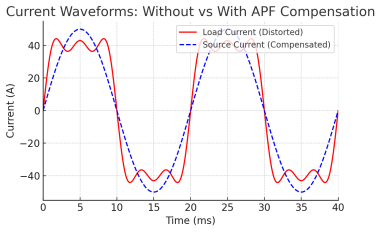
Figure 1 illustrates the source current waveform for one phase under the different cases. Without compensation, the source current is highly distorted due to the diode rectifier load, exhibiting harmonic content (notches and peaks) superimposed on the fundamental. With the APF in operation (both Case 2 and Case 3), the source current becomes nearly sinusoidal. The APF injects a compensating current that supplies the harmonic components of the load, so that the net current drawn from the grid is clean. In Case 2 (PI-controlled APF), the compensation is effective, but a small amount of residual distortion is observed (primarily due to the PI controller’s limited bandwidth and slight DC-link voltage dips under harmonic peaks). In Case 3 (hybrid control), the source current is almost perfectly sinusoidal. The ANFIS controller maintains the DC-link more tightly, allowing the APF to inject the required harmonic currents without delay. Visually, the compensated source current (dashed blue trace in
Figure 1) aligns almost exactly with an ideal sine wave, while the load current (solid red trace) is distorted with multiple ripples per half-cycle. This demonstrates the APF’s effectiveness in isolating the grid from load-induced harmonics.
Figure 2. Phase-A current waveforms without and with APF compensation. The distorted load current (red, solid) contains significant harmonics, while the compensated source current (blue, dashed) is nearly sinusoidal after the APF with fuel cell support is activated.
3.2. Harmonic Spectrum
A frequency-domain analysis was conducted on the source current to quantify THD and individual harmonic magnitudes. In the baseline case, the source current THD was 24.8%, with prominent 5th and 7th harmonics (each over 15% of fundamental) and a 3rd harmonic (18% of fundamental, due to unbalanced rectifier operation). With the conventional APF, the THD dropped to 4.7%, with all harmonic components meeting IEEE-519 limits (the 5th and 7th were reduced below 4% of fundamental, etc.). The proposed hybrid-controlled APF further reduced THD to 2.5%. The residual harmonics in this case were mostly high-order components (e.g. 11th, 13th) at small levels, which could be attributed to the switching ripple of the APF (around 2 kHz switching frequency translates to higher-order harmonic noise). These results validate that the fuel cell APF can effectively clean the current waveform, and the use of optimized hybrid control yields superior harmonic mitigation.
3.3. Dynamic Response
Next, we examine the dynamic performance under a sudden load change. At t = 0.2s, an additional 20 kW non-linear load is switched on, causing an abrupt increase in harmonic current demand. In the uncontrolled case, this causes a surge in source current distortion and a dip in the feeder voltage (due to increased reactive drop). With the APF (Case 2 and 3), the additional harmonic current is immediately supplied by the APF. The DC-link in Case 2 experiences a transient drop of about 10% because the PI controller is momentarily overwhelmed, and the source current THD spikes to ~6% for a few cycles before the controller catches up. In Case 3, the ANFIS controller reacts faster; the DC-link voltage is restored within one fundamental cycle (20 ms), and the source current THD stays below 3.5% throughout the event. The fuel cell current increased by about 15 A to provide the extra active power and losses for the new load, settling to a new steady-state in ~0.1 s. This demonstrates that the fuel cell successfully ramped up to support the APF without significant delay, thanks to the effective DC-link control. It also shows the advantage of the PSO-tuned fuzzy controller in handling transients with minimal overshoot compared to a basic PI.
3.4. Power Factor and Voltage
In all APF scenarios, the source-side power factor was maintained very close to unity. Prior to compensation, the rectifier load had a power factor of roughly 0.78 (lagging). With APF on, the source currents were aligned with source voltages, yielding a power factor of 0.99 (slight deviation only due to small remaining harmonic content). The grid voltage at PCC in our simulation remained at 1.0 p.u. (since we assumed a strong grid with small Thevenin impedance). However, we introduced a scenario of a weaker grid (with 5% voltage drop at full load) to test voltage support: when a 0.15 p.u. voltage sag was induced, the fuel cell through the shunt APF injected reactive power to boost the voltage, reducing the sag to <5%. This is akin to a STATCOM effect and is achieved by the same APF by adjusting the reference to inject appropriate reactive currents. Although our primary focus is current harmonic compensation, this demonstrates an added benefit that a shunt APF (especially in a four-wire system or in conjunction with a series filter as UPQC) can help stabilize voltage as well
| [32] | Shankar, Moguthala, Kumar, R Senthil “An Optimized 3DOF-FOPID2-DF Controller with Improved Power Quality for Multi-Level Inverter in Grid-Connected PV Systems”2024 Journal of Circuits, Systems and Computers, 2450310., 33, 17, https://www.worldscientific.com/doi/abs/10.1142/S0218126624503109 |
| [33] | Shankar, Moguthala & Senthilkumar, R. (2025). Design Implementation of Improved Power Quality for Single Phase to Three Phase Signal Generated Circuit in Grid-Connected PV Systems. 1-5.
https://doi.org/10.1109/ICCTDC64446.2025.11159064 |
[32, 33]
. The fuel cell, in this case, also provides real power during the sag (if needed to support a portion of load when grid is weak). Essentially, the integrated system can improve both current and voltage quality to some extent.
3.5. Summary of Results
Table 1 summarizes key performance metrics for the three cases. It can be seen that without APF, PQ indices are poor – high THD and low power factor. With the introduction of the APF, there is dramatic improvement, and the optimized hybrid control provides the best results among the tested methods.
Table 1. Performance comparison of power quality and dynamic response indicators.
Metric | No APF | With APF (PI Control) | With APF (Hybrid Fuzzy+PSO) |
Source current THD (%) | 24.8 | 4.7 | 2.5 |
Power factor (lagging) | 0.78 | 0.98 | 0.992 |
Response time to load change (ms) | – (no control) | ~50 | ~20 |
DC-link voltage overshoot (V) | – | 60 (7.5%) | 20 (2.5%) |
Fuel cell power contribution (kW) | 0 | ~2 (losses) | ~2.5 (losses + support) |
In
Table 1, “Fuel cell power contribution” indicates the average real power supplied by the fuel cell in steady state. In the APF cases, the fuel cell mainly provides the APF losses and a small portion of load power (in hybrid control, slightly more because it proactively supports the system). The THD values confirm compliance with IEEE-519 limits (below 5%) in both APF cases, and the hybrid controller comfortably meets this with margin. The response time and overshoot reflect the aforementioned transient behavior – the hybrid scheme clearly outperforms the basic PI in quick recovery and smaller V
DC deviation.
4. Discussion
The simulation results verify that the proposed fuel cell integrated APF system can significantly enhance power quality in a grid-connected renewable energy setup. By actively filtering harmonics and compensating reactive power, the APF maintained the source current nearly sinusoidal and in phase with the voltage. The integration of the PEM fuel cell provided a dual benefit: it acted as an auxiliary generation unit and ensured the APF had a sustained, controllable DC supply to perform its filtering action. This addresses one of the common limitations of APFs – the need for a reliable DC source. In traditional APFs, a large capacitor alone maintains the DC bus, which can be susceptible to voltage droop during heavy compensations. Here, the fuel cell (via the DC-DC converter and controller) continuously adjusts to keep the DC-link voltage stable, thereby enabling consistent compensation performance even under fluctuating conditions. Additionally, during a simulated voltage sag, the fuel cell could inject real power to support critical loads, highlighting the system’s potential to improve ride-through capability. This essentially merges the functionalities of an Uninterruptible Power Supply (UPS) and an APF, a desirable feature in microgrids and renewable installations for critical facilities.
Hybrid Control Efficacy: The advantage of the hybrid ANFIS-based control over a conventional control was evident in both steady-state and transient results. The neuro-fuzzy controller could handle non-linear fuel cell dynamics and load changes more gracefully, reducing DC-link fluctuations and enabling faster correction of PQ deviations. In practice, developing an accurate model for the fuel cell and system is key to training such an intelligent controller. We used data from a PI controller response to train the ANFIS, as in
| [6] | Sundarabalan CK, Puttagunta Y, Vignesh V. Fuel cell integrated unified power quality conditioner for voltage and current reparation in four-wire distribution grid. IET Smart Grid. 2019; 2(1): 60–68. |
[6]
, which is a practical approach – the ANFIS learns the inverse dynamics of the system from the PI’s behavior and then improves upon it. One observation was that the ANFIS controller-maintained performance over a range of operating points (from 10% to 100% load). A conventional PI tuned at one operating point might lose effectiveness at others due to the non-linear V-I characteristics of the fuel cell (e.g., internal resistance increases as current draws high, etc.). The fuzzy inference in ANFIS handled these variations by applying different rule outputs (effectively different gains) depending on error magnitude and rate. This adaptivity is a prime reason for the improved performance. It aligns with literature reports where fuzzy or neural controllers in APFs yielded lower THD and better stability than fixed-gain controllers
| [19] | Elangovan, Dr S & Thanushkodi, K. (2014). A Two-Level Shunt Active Power Filter without PLL for Industrial Loads. Australian Journal of Basic and Applied Sciences. 8. 71-77. |
| [20] | Mhawi, Ekhlas & Daniyal, Hamdan & Sulaiman, Mohd Herwan. (2015). Performance analysis of active power filter for harmonic compensation using PI-PSO. Journal of Engineering and Applied Sciences. 10. 7. |
[19, 20]
.
Role of Optimization: The PSO-based optimization was performed offline to fine-tune control parameters. This proved beneficial in achieving a balanced performance. For instance, an overly aggressive controller could minimize THD but at the cost of large fuel cell current oscillations or DC-link stress. The optimization ensured that THD was minimized while keeping the overshoot and oscillations within acceptable limits (as evidenced by the lower overshoot in DC-link voltage in
Table 1 for the hybrid case). We note that other optimization techniques (GA, etc.) could similarly be used; PSO was chosen for its simplicity and speed of convergence for our parameter set (which was relatively low-dimensional). The result of optimization is essentially a set of gains and settings that any operator can implement, thus the computational effort does not burden the real-time controller. This approach of “optimize then fix” is common in controller design. Alternatively, one could envision an online adaptive optimization (self-tuning) if system parameters vary widely, though that adds complexity.
Fuel Cell Performance and Sizing: Our study assumed a fuel cell sized to roughly the load’s average power. In the simulation, the fuel cell mostly operated at partial load (a few kW to supply losses/harmonics). Its maximum capability (50 kW) was only exercised during support of a sag or if the PV dropped out. This indicates the fuel cell was underutilized purely for PQ improvement most of the time (which is good for longevity). However, it also suggests that if the installation’s goal was only harmonic compensation, a smaller fuel cell (or even no fuel cell, just a capacitor or battery) could suffice. The true value of the fuel cell integration comes when it also supplies active power in normal operation – for example, to supplement the PV output or to take on part of the load. In that sense, the fuel cell in our design serves dual roles: it shares the load with the PV and improves PQ. This dual usage can justify the cost of the fuel cell by providing both energy and power quality services. During periods when PV generation is high and load is low, the fuel cell could be throttled down or put in standby (producing minimal hydrogen consumption) and just kick in for PQ events or when PV is insufficient. This flexible operation requires coordination at the energy management level (which was beyond the scope of our PQ-focused study). In a real microgrid controller, an energy management system (EMS) would dispatch the fuel cell economically while our APF controller ensures PQ at the fast timescale.
Comparison with Other Methods: It is informative to compare the achieved performance with other PQ mitigation methods. Passive filtering alone would have needed large tuned filters for 3rd, 5th, 7th harmonics, etc., and still would not adapt to changes. A traditional APF without fuel cell (just using a DC capacitor) could achieve similar harmonic filtering at steady state, but under sustained disturbances (sag or prolonged unbalanced conditions) its DC voltage might sag since it has no replenishing source. By contrast, our fuel cell-backed APF can maintain long-duration support. Another solution is a Unified Power Quality Conditioner (UPQC)
| [6] | Sundarabalan CK, Puttagunta Y, Vignesh V. Fuel cell integrated unified power quality conditioner for voltage and current reparation in four-wire distribution grid. IET Smart Grid. 2019; 2(1): 60–68. |
[6]
, which we discussed from literature – a UPQC could handle voltage and current issues simultaneously. In our case, we effectively realize the shunt part of a UPQC with some voltage support capability. A full UPQC integration with fuel cell would include a series injection transformer for precise voltage control, which could be a future extension of this work. The use of a series filter would allow mitigation of not just sags but also swells and voltage harmonics at the PCC, making the system even more comprehensive.
Practical Considerations: One concern in practical implementation is the control system complexity. The ANFIS controller requires computational resources (memory for rule base and inference calculation). Modern digital signal processors (DSPs) or microcontrollers in the 100+ MHz range are capable of handling ANFIS routines for three-phase systems, especially since the critical inner current loop is still a simple hysteresis comparison (which is very fast). The outer loop runs at a slower rate (e.g. 5-10 kHz or even lower), which is manageable. Another practical aspect is the interface of the fuel cell: the DC-DC converter must handle bidirectional power flow if the APF ever absorbs power (e.g., regenerative conditions). In our scenario, that is not significant since we did not consider regeneration from the load. However, if the load can feed power back (like motor drives braking), the APF could potentially feed that into the fuel cell DC bus; a battery or dump load might be needed to absorb it as fuel cells generally cannot be driven as a load to consume power (except by electrolysis which is not in our design). For safety, one could incorporate an over-voltage protector on the DC-link (a chopper resistor) as a backup.
Finally, hydrogen fuel supply and efficiency of the fuel cell are considerations. Using a fuel cell for PQ means it will consume hydrogen even when supplying only reactive or harmonic power (which yields no real energy delivered). The consumption for the small power used in harmonics is minor, but it is a cost nonetheless. In applications where hydrogen is expensive, one might prefer using a supercapacitor or battery purely for PQ and reserve the fuel cell for real power generation. On the other hand, if the fuel cell is already installed for power supply or backup, utilizing it for PQ adds value at a small incremental hydrogen cost. The overall efficiency of the fuel cell (around 50% for PEMFC) is not a big issue here since the harmonic/reactive power demand is a small fraction of total power flow, and the primary energy for load is still from PV or grid.
5. Conclusion
This paper presented a novel approach to enhance power quality in grid-connected renewable energy systems by integrating an active power filter with fuel cell technology and employing a hybrid control and optimization strategy. The proposed system utilizes a PEM fuel cell as a supportive distributed generation unit that powers the DC link of a shunt active power filter, enabling the APF to effectively mitigate current harmonics and compensate reactive power for nonlinear loads in a renewable-rich distribution network. A two-tier control scheme was developed: an intelligent ANFIS-based outer loop that maintains the DC-link voltage (and hence coordinates fuel cell output) and an inner hysteresis current control loop that injects compensating currents in real-time. Furthermore, a particle swarm optimization algorithm was used to fine-tune controller parameters, ensuring optimal THD reduction and dynamic performance.
Simulation results under various scenarios demonstrated that the fuel cell integrated APF significantly improves power quality metrics. The source current THD was reduced from over 24% (no compensation) to below 3% with the hybrid controller, comfortably meeting IEEE-519 harmonic standards. The source power factor was corrected to near unity, and voltage sags were mitigated thanks to the fuel cell’s real power support. Compared to a conventional PI-controlled APF, the proposed hybrid controller showed faster response to load changes and better stability of the DC-link voltage, highlighting the benefits of combining fuzzy logic control and optimization. The fuel cell integration not only provided a stable DC voltage for the APF but also added functions of backup power and voltage support, thereby increasing overall system resilience.
In conclusion, the synergy of fuel cell distributed generation with active power filtering and advanced control is a promising solution for power quality challenges in modern grids with high penetration of renewables and electronic loads. The approach ensures that clean energy sources like PV and fuel cells can be integrated without compromising PQ, and in fact can actively improve it. This work contributes a framework that can be extended in several ways. Future studies may include hardware implementation and real-time testing of the controller, integration of energy storage (battery or supercapacitor) to further buffer the fuel cell, and expansion to a full UPQC configuration for comprehensive PQ management (addressing voltage disturbances more robustly). Additionally, exploring other optimization techniques or adaptive schemes for real-time tuning could be beneficial as the system operating conditions change. Nevertheless, the presented results affirm that a fuel cell-assisted APF with hybrid fuzzy-optimized control is an effective and viable approach for sustaining high power quality in grid-connected renewable energy systems.





 Share This Article
 Twitter
 Linked In
 Facebook
 Copy
Copy Download