
This article investigates the limitations of pyrometric technology in the visible and ultraviolet spectral bands. These studies rely on a theoretical analysis of thermal radiation, Planck's fundamental laws, and multispectral processing methods based on nonlinear models. Accurate high-temperature measurement is a major challenge in many scientific and industrial fields, including thermal processes, metallurgy, energy, and fundamental research. Uncertainty in emissivity is the main source of error in conventional pyrometric measurements. To reduce the influence of emissivity and improve measurement reliability, several approaches have been developed, including monochromatic, bichromatic, and multispectral pyrometry based on Planck's law. The chromatic luminance characteristics in the visible and ultraviolet bands, obtained from a temperature range across both spectral domains, highlight the high potential of pyrometry for measuring high temperatures in complex environments. These characteristics will be applied with different wavelengths in each visible and ultraviolet spectral band. Comparative studies of the results will be able to highlight the limitations for each band. Compared to traditional approaches, this pyrometry technology offers a small advantage for detecting very high temperatures despite variations in emissivity and environmental uncertainties. The luminance for these two spectral bands exhibits a very low flux almost at temperatures below 1900K.
| Published in | Journal of Electrical and Electronic Engineering (Volume 14, Issue 3) |
| DOI | 10.11648/j.jeee.20261403.12 |
| Page(s) | 135-142 |
| Creative Commons |
This is an Open Access article, distributed under the terms of the Creative Commons Attribution 4.0 International License (http://creativecommons.org/licenses/by/4.0/), which permits unrestricted use, distribution and reproduction in any medium or format, provided the original work is properly cited. |
| Copyright |
Copyright © The Author(s), 2026. Published by Science Publishing Group |
Wavelength, Pyrometer, Visible Spectrum, Ultraviolet Spectrum, Temperature, Luminance, Emissivity
| [1] | L. DEJAEGHERE, Measurement method using multispectral pyrometry and development of a high-temperature device, Ph.D. Thesis, University of South Bretagne, 2016. |
| [2] | P. E. RATIANARIVO, Optimization of wavelength selection for a quadraspectral pyrometer for the austenitization of steels, Ph.D. Thesis, University of Antananarivo, 2018. |
| [3] |
Th. Duvaut, Comparison between multiwavelength infrared and visible pyrometry: Application to metals,
https://www.sciencedirect.com/science/article/pii/S1350449507001375 |
| [4] | P. POUPEAU, Heat Treatments of Metals and Alloys (M1105), Engineering Techniques Edition, Metallic Materials Treatise. |
| [5] | J. P. BARDON, Surface Temperatures, Fundamental Concepts (R2730) Engineering Techniques Edition. |
| [6] |
TairanFu, MinghaoDuan, JiaqiTang, ConglingShi, Measurements of the directional spectral emissivity based on a radiation heating source with alternating spectral distributions,
https://www.sciencedirect.com/science/article/pii/S001793101500784X |
| [7] | G. R. Gathers, Analysis of multiwavelength pyrometry using nonlinear chi-square fits and Monte Carlo methods, |
| [8] |
M. Boivineau, G. Pottlacher, Thermophysical properties of metals at very high temperatures obtained by dynamic heating techniques: recent advances,
https://www.inderscienceonline.com/doi/pdf/10.1504/IJMPT.2006.009468 |
| [9] | Simone MATTEÏ, Thermal radiation from opaque materials |
| [10] | Tairan Fu, Jiangfan Liu, Minghao Duan, Anzhou Zong, Temperature measurements using multicolor pyrometry in thermal radiation heating environments, |
| [11] |
Christophe Rodiet, Benjamin Rémy, Alain Degiovanni, Franck Demeurie, – Optimisation of wavelengths selection used for the multi-spectral temperature measurement by ordinary least squares method of surfaces exhibiting non-uniform emissivity,
https://www.tandfonline.com/doi/abs/10.1080/17686733.2013.812816 |
| [12] |
AntónioAraújo, Dual-band pyrometry for emissivity and temperature measurements of gray surfaces at ambient temperature: The effect of pyrometer and background temperature uncertainties,
https://www.sciencedirect.com/science/article/pii/S0263224116304687 |
| [13] |
Philippe Herve, Julie Cedelle, Ionut Negreanu, Infrared technique for simultaneous determination of temperature and emissivity,
https://www.sciencedirect.com/science/article/pii/S1350449510000721 |
| [14] |
Christophe Rodiet, Benjamin Remy, Alain Degiovanni, Optimal wavelengths obtained from laws analogous to the Wien’s law for monospectral and bispectral methods, and general methodology for multispectral temperature measurements taking into account global transfer function including non-uniform emissivity of surfaces,
https://www.sciencedirect.com/science/article/pii/S1350449516300147 |
| [15] | C. RODIET, T. PIERRE, B. REMY et A. DEGIOVANNI, Temperature measurement by multispectral method in the infrared and ultraviolet |
| [16] |
Jinlong Chen, Yongcai Guo, Dongying Wang, Shaoqian Xue, Min Jiao, Chao Gao, A data processing method for two-Color pyrometers in accurate temperature measurement of high-temperature flow fields,
https://www.sciencedirect.com/science/article/pii/S0263224124023169 |
| [17] |
Zongju Yang, Bo Wang, Jingmin Dai, Zhijian Hu, Development of multi-spectral pyrometer for measuring cathode surface temperature of pulsed vacuum arc discharge,
https://www.sciencedirect.com/science/article/pii/S2211379723008070 |
| [18] | Christophe Rodiet, Temperature Measurement by Multi-Spectral Methods and Thermal Characterization of Anisotropic Materials by Integral Transformations: Theoretical and Experimental Aspects, Doctoral thesis, Ph.D. Thesis; Mechanics and Energetics; EMMA Doctoral School: Mechanical Energy and Materials; 2014. |
APA Style
Ezekel, R. P., Elisee, R. (2026). Limitations of Pyrometer Technology in the Ultraviolet and Visible Spectral Bands According to Planck's Law on the Real Body. Journal of Electrical and Electronic Engineering, 14(3), 135-142. https://doi.org/10.11648/j.jeee.20261403.12
ACS Style
Ezekel, R. P.; Elisee, R. Limitations of Pyrometer Technology in the Ultraviolet and Visible Spectral Bands According to Planck's Law on the Real Body. J. Electr. Electron. Eng. 2026, 14(3), 135-142. doi: 10.11648/j.jeee.20261403.12
@article{10.11648/j.jeee.20261403.12,
  author = {Ratianarivo Paul Ezekel and Rastefano Elisee},
  title = {Limitations of Pyrometer Technology in the Ultraviolet and Visible Spectral Bands According to Planck's Law on the Real Body},
  journal = {Journal of Electrical and Electronic Engineering},
  volume = {14},
  number = {3},
  pages = {135-142},
  doi = {10.11648/j.jeee.20261403.12},
  url = {https://doi.org/10.11648/j.jeee.20261403.12},
  eprint = {https://article.sciencepublishinggroup.com/pdf/10.11648.j.jeee.20261403.12},
  abstract = {This article investigates the limitations of pyrometric technology in the visible and ultraviolet spectral bands. These studies rely on a theoretical analysis of thermal radiation, Planck's fundamental laws, and multispectral processing methods based on nonlinear models. Accurate high-temperature measurement is a major challenge in many scientific and industrial fields, including thermal processes, metallurgy, energy, and fundamental research. Uncertainty in emissivity is the main source of error in conventional pyrometric measurements. To reduce the influence of emissivity and improve measurement reliability, several approaches have been developed, including monochromatic, bichromatic, and multispectral pyrometry based on Planck's law. The chromatic luminance characteristics in the visible and ultraviolet bands, obtained from a temperature range across both spectral domains, highlight the high potential of pyrometry for measuring high temperatures in complex environments. These characteristics will be applied with different wavelengths in each visible and ultraviolet spectral band. Comparative studies of the results will be able to highlight the limitations for each band. Compared to traditional approaches, this pyrometry technology offers a small advantage for detecting very high temperatures despite variations in emissivity and environmental uncertainties. The luminance for these two spectral bands exhibits a very low flux almost at temperatures below 1900K.},
 year = {2026}
}
TY  - JOUR
T1  - Limitations of Pyrometer Technology in the Ultraviolet and Visible Spectral Bands According to Planck's Law on the Real Body
AU  - Ratianarivo Paul Ezekel
AU  - Rastefano Elisee
Y1  - 2026/05/14
PY  - 2026
N1  - https://doi.org/10.11648/j.jeee.20261403.12
DO  - 10.11648/j.jeee.20261403.12
T2  - Journal of Electrical and Electronic Engineering
JF  - Journal of Electrical and Electronic Engineering
JO  - Journal of Electrical and Electronic Engineering
SP  - 135
EP  - 142
PB  - Science Publishing Group
SN  - 2329-1605
UR  - https://doi.org/10.11648/j.jeee.20261403.12
AB  - This article investigates the limitations of pyrometric technology in the visible and ultraviolet spectral bands. These studies rely on a theoretical analysis of thermal radiation, Planck's fundamental laws, and multispectral processing methods based on nonlinear models. Accurate high-temperature measurement is a major challenge in many scientific and industrial fields, including thermal processes, metallurgy, energy, and fundamental research. Uncertainty in emissivity is the main source of error in conventional pyrometric measurements. To reduce the influence of emissivity and improve measurement reliability, several approaches have been developed, including monochromatic, bichromatic, and multispectral pyrometry based on Planck's law. The chromatic luminance characteristics in the visible and ultraviolet bands, obtained from a temperature range across both spectral domains, highlight the high potential of pyrometry for measuring high temperatures in complex environments. These characteristics will be applied with different wavelengths in each visible and ultraviolet spectral band. Comparative studies of the results will be able to highlight the limitations for each band. Compared to traditional approaches, this pyrometry technology offers a small advantage for detecting very high temperatures despite variations in emissivity and environmental uncertainties. The luminance for these two spectral bands exhibits a very low flux almost at temperatures below 1900K.
VL  - 14
IS  - 3
ER  -
Electronic Department, Polytechnical High School of Antsirabe, Antsirabe, Madagascar
Biography: Ratianarivo Paul Ezekel is a professer at Polytechnical High School of Antsirabe, Vakinankaratra University, Electronic Engineering Department. He completed his PhD in Electronic Divices et Systems Engineering from Antananarivo University in 2018, and his Master of Engineering in Automatic Electronic Systems from Polytechnical High School of Antananarivo in 2010. Recognized for his exceptional contributions, Dr. Ratianarivo Paul Ezekel has been known as the chef department of electronic engineering at Polytechnical High School of Antsirabe.
Research Fields: Electronic system, Instrumentation, Embedded systems, programmable system, spintronic

Electronic Department, Polytechnical High School of Antananarivo, Antananarivo, Madagascar
Biography: Rastefano Elisee is a professer at Polytechnical High School of Antananarivo, and Doctoral School of Science and Technology of Engineering and Innovation, University of Antananarivo, Electronic Engineering Department. As a teacher, he is the founder of electronic engineering formation in Madagascar. Recognized for his exceptional contributions, Rastefano Elisee has been known as the chef department of electronic engineering at Polytechnical High School of Antananarivo during long time and head of the doctoral reception team of embedded systems, instrumentation, electronic system modeling.
Research Fields: Semiconductor, electronic system, signal processing, spintronic
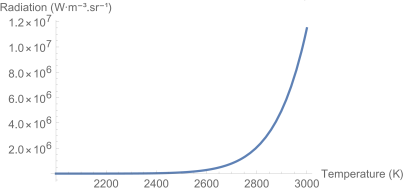
Figure 1. Radiation in ultraviolet spectrum range at a wavelength of 0.2µm.
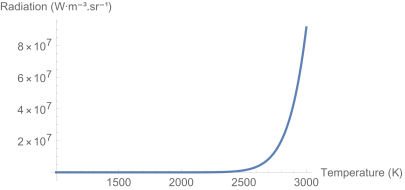
Figure 2. Radiation in ultraviolet spectrum range at a wavelength of 0.225µm.
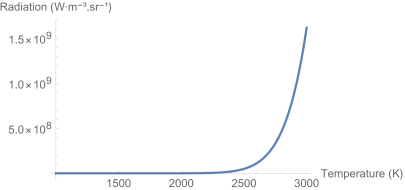
Figure 3. Radiation in ultraviolet spectrum range at a wavelength of 0.275µm.
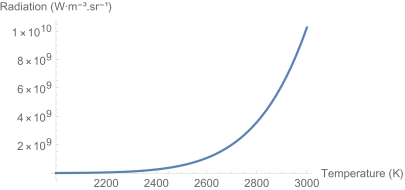
Figure 4. Radiation in ultraviolet spectrum range at a wavelength of 0.325µm.
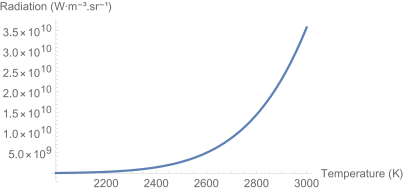
Figure 5. Radiation in ultraviolet spectrum range at a wavelength of 0.375µm.
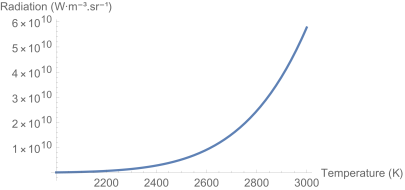
Figure 6. Radiation in ultraviolet spectrum range at a wavelength of 0.4µm.
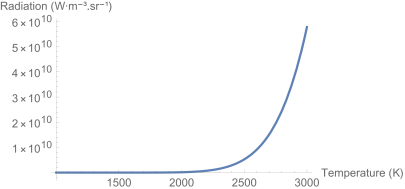
Figure 7. Radiation in visible spectrum range at a wavelength of 0.4 µm.
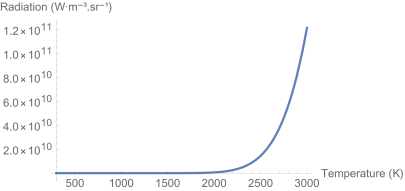
Figure 8. Radiation in visible spectrum range at a wavelength of 0.45µm.
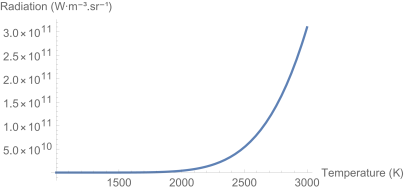
Figure 9. Radiation in visible spectrum range at a wavelength of 0.55µm.
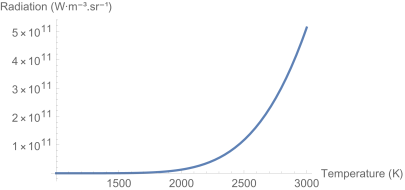
Figure 10. Radiation in visible spectrum range at a wavelength of 0.65µm.
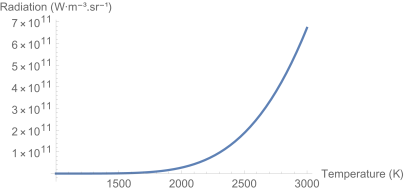
Figure 11. Radiation in visible spectrum range at a wavelength of 0.75µm.
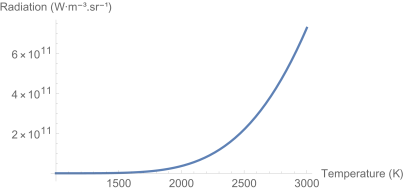
Figure 12. Radiation in visible spectrum range at a wavelength of 0.8µm.

Information



 Share This Article
 Twitter
 Linked In
 Facebook
 Copy
Copy Download